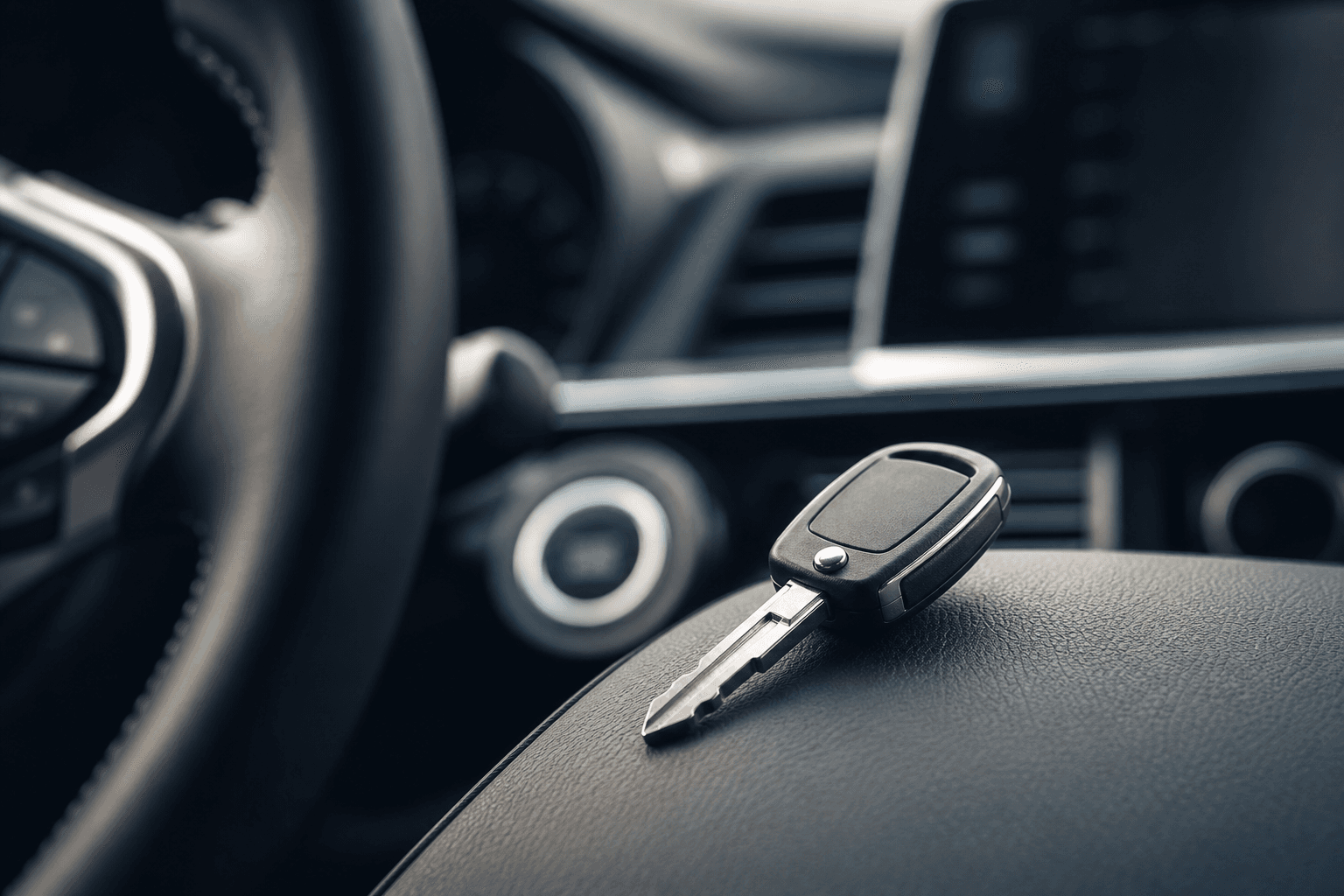
What's actually inside a push-to-start key fob
A modern push-to-start fob isn't really a "key" in the old sense — it's a small radio. Inside, there are typically four components:
- A passive transponder chip that responds to a low-frequency signal from the car when you're inside the cabin (this is what authorizes the engine start)
- A remote-control transmitter that sends button presses (lock, unlock, trunk) to the car over a separate higher-frequency band
- A rolling-code microcontroller that prevents replay attacks (the code changes every press)
- A physical emergency key blade hidden inside the fob, used to unlock the door if the fob battery dies
Replacing the fob means cutting a new emergency blade to your car's lock cylinder AND programming the transponder + remote codes into the car's immobilizer. Skipping either step means the key won't work.
Why a hardware-store key won't start a modern car
If you take a 2016+ vehicle to a hardware-store kiosk and have a "key" cut, you'll get a blank metal blade that can mechanically slide into the ignition or door cylinder. It will not start the engine. The car's immobilizer reads the transponder chip via the antenna ring around the ignition or push-start button — and a hardware-store cut blade has no chip. This is a frequent and frustrating call for us: customer pays $30 at a kiosk, gets home, key won't start the car, calls dispatch furious. The hardware-store cut isn't useless (it works as a door key in most cars), but for engine-start you need the transponder programmed.
How a mobile automotive locksmith replaces a smart key
When the van arrives at your driveway, the technician will:
- Verify VIN and ownership — they'll ask for your registration or title and a photo ID. We won't program a key for a car that isn't yours.
- Cut the physical emergency blade to the car's lock cylinder. We use a code-cutter that takes the cuts from the VIN's key code (or directly from a lock if needed).
- Connect to the car's diagnostic port (the OBD-II port under the dash) with a programming tool — typically Autel IM608, Topdon Phoenix, or similar high-end aftermarket scanner.
- Authenticate with the car's immobilizer. On most makes this requires a manufacturer security code that the tool requests from a paid online service in real time. This is where the legitimate cost comes in — those service charges are real and per-key.
- Program the new fob as either an additional key (if you still have a working one) or as a "lost all keys" reset (more expensive, requires more security steps).
- Test the new key — start the car, lock/unlock the doors, test the trunk and any panic buttons.
Elapsed time: typically 30-60 minutes for an "additional key" job, 60-90 minutes for a "lost all keys" job. We do this in your driveway, your office parking lot, or wherever the car is stuck.
Real 2026 pricing by category
Push-to-start key replacement pricing in California in 2026:
- Duplicate of an existing smart key (you have at least one working): $250-$400
- Lost all keys, mainstream make (Toyota, Honda, Ford, Chevy, Nissan, Hyundai, Kia): $450-$700
- Lost all keys, luxury (BMW, Mercedes, Audi, Lexus, Porsche, Tesla): $600-$1,200
- Some 2020+ Mercedes, BMW, Audi, Porsche, Range Rover — dealer-only programming, $1,000-$2,500 (we'll tell you on the phone if you fall in this bucket)
Dealers typically charge 2-3x these numbers for mainstream cars and require a tow ($150-$400 in LA). The total dealer cost on a "lost all keys" Toyota is often $900-$1,500 by the time the car is back in your hands, vs $450-$700 for a mobile locksmith in your own driveway.
What can go wrong (and how a real locksmith handles it)
Honest answer: not every push-to-start replacement goes smoothly the first time. The two most common issues:
- OEM security gateway: some 2018+ Mopar (Chrysler/Dodge/Jeep/Ram) and 2020+ Mercedes-Benz vehicles have a security gateway that locks out aftermarket programming. We'll tell you up front whether your year/make/model is gateway-locked. If it is, we can sometimes still program with a manufacturer authorization (extra step, extra cost), or we'll be honest and refer you to the dealer.
- Dead 12V battery: programming requires the car's electronics to be live. If the battery is fully dead, we have to jump it first. Adds 5-10 minutes, no extra charge.
The sign of a real automotive locksmith vs a generalist: they ask for year, make, model, and trim on the phone before quoting. That tells them whether your car is gateway-locked, what tooling is needed, and what blank to bring. A generalist who just says "we'll figure it out on site" is going to either waste your time or surprise you with a bill increase.